



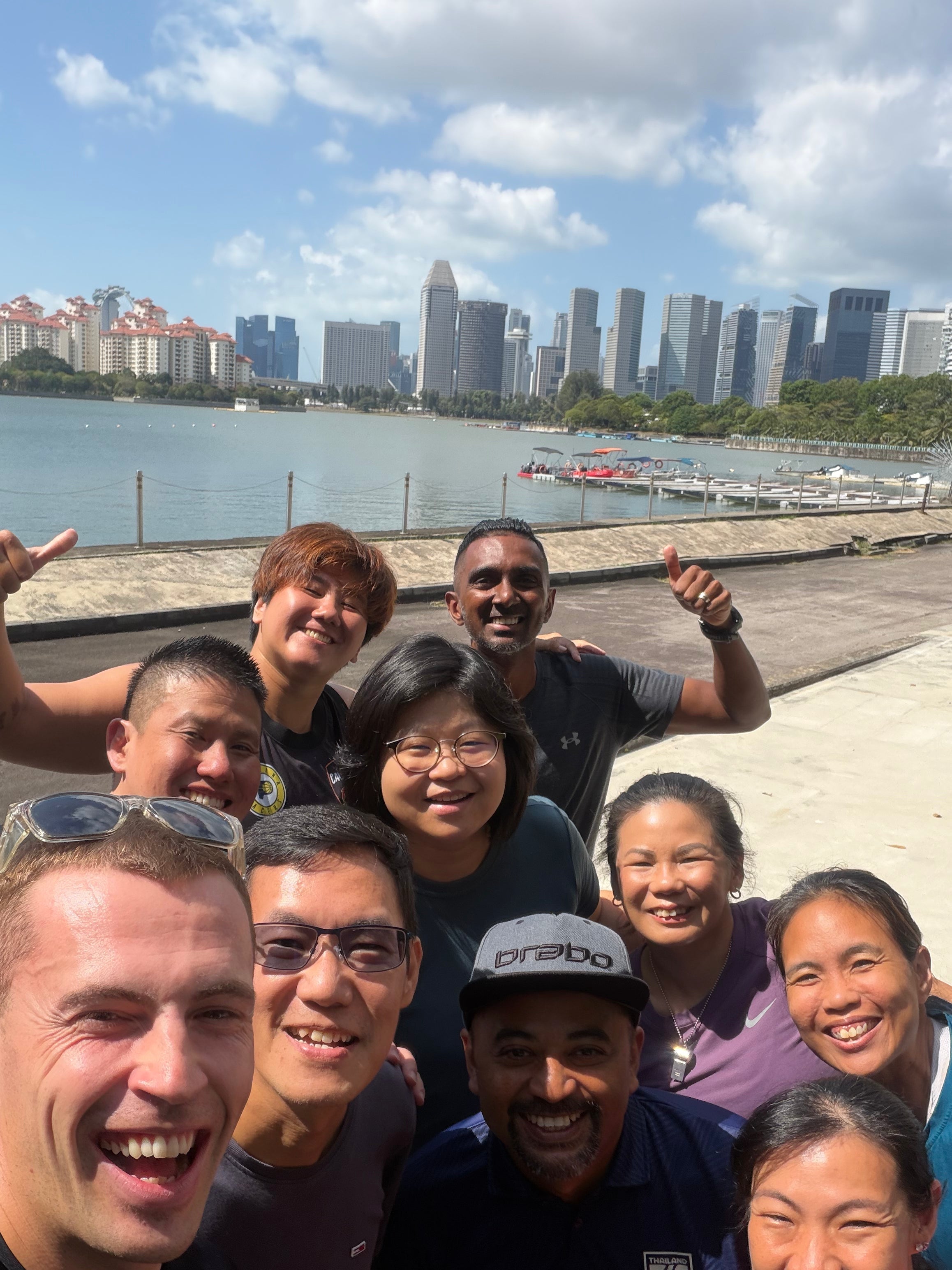
Challenging Coaches in Singapore With ActiveSG and Singapore Netball Academy
Singapore, you were brilliant.
We recently had the opportunity to support coaches from ActiveSG and Singapore Netball Academy, bringing together practical games, Coach Challenge MatchPlay Cards and meaningful conversations about what great sporting experiences should feel like.
Rather than relying on long lectures or expecting coaches to copy one preferred coaching method, the sessions invited coaches to play, observe, experiment and challenge one another.
Our theme was simple: do not just deliver the activity. Design the experience.

Different sports, shared coaching challenges
ActiveSG and Singapore Netball Academy work across different sporting environments, but their coaches face many of the same challenges.
Together, we explored questions such as:
- How do we engage every player?
- How can we challenge individuals without removing them from the game?
- When should a coach intervene?
- Are players making decisions or waiting for instructions?
- Does the activity reward the behaviour we want to develop?
- What happens when players receive more ownership?
These are not simply football or netball questions. They are coaching questions that apply across sports, age groups and levels of performance.
Rather than discussing them from the side, coaches explored the questions through games. They were able to test ideas, observe how the environment responded and decide what they might retain or change.
Changing the game to change behaviour
A game can change completely when the coach adjusts one carefully selected detail.
Changing the scoring system can alter what players value. Reducing the space can increase pressure and speed up decisions. Giving one player a secret challenge can allow them to experience the same game through a different lens.
Coaches explored how they could adapt:
- Space
- Time
- Player numbers
- Scoring systems
- Rules and conditions
- Individual challenges
- Team missions
- The information available to players
The important part was the purpose behind each change. Adding a condition does not automatically improve a game, so coaches needed to consider what the change encouraged players to notice, decide or attempt.
If you want players to communicate, can you design a game in which communication helps them succeed?
If you want players to scan, can the game reward what they notice before receiving?
If one player needs greater challenge, can you change their experience without restricting everybody else?
The answers came through playing, testing and adapting rather than through being given another session plan.

Pick a card and accept the challenge
The Coach Challenge MatchPlay Cards became a central part of the experience.
The deck contains 70 practical coaching challenges across three areas:
- ENGAGE: Challenges that help coaches increase player ownership, involvement and connection.
- CHANGE: Challenges that encourage coaches to adapt their communication, behaviours, interventions and session design.
- REFLECT: Challenges that help coaches notice more, examine their decisions and plan what they will try next.
These are not drills for coaches to copy. They challenge how coaches communicate, notice, design and respond.
Coaches selected challenges for themselves based on something they wanted to explore. They also selected cards for their peers based on what they had observed.

A coach might be challenged to:
- Speak less and observe what the players do.
- Involve a quieter player in a conversation.
- Change the game without stopping it.
- Give one player a different route to success.
- Allow players to lead the review.
- Focus their attention on players they would not normally watch.
The card gave the coach a mission, but it did not provide the solution. Each coach needed to read the game, consider the people in front of them and decide how to respond.
Can you coach without stopping the game?
One challenge created plenty of debate: can you influence the players without stopping the activity?
Stopping a game gives the coach control and creates an opportunity to correct, explain or reorganise. However, frequent interruptions can also reduce playing time, disrupt decision making and teach players to wait for the coach before solving a problem.

We encouraged coaches to explore alternative interventions:
- Change the scoring system while the game continues.
- Speak with one player away from the action.
- Ask a short question without bringing everybody together.
- Introduce a new challenge or condition.
- Allow players to request support when they need it.
- Give players more time to recognise and solve the problem.
We were not suggesting that coaches should never stop an activity. Stopping the game remains a valuable option when it serves a clear purpose.
The challenge encouraged coaches to expand the range of interventions available to them and select the one that best suited the moment.
Coaches challenging coaches
Some of the most valuable learning came from coaches giving feedback to one another.
One coach led the activity while their peers observed through different lenses. Rather than everyone attempting to evaluate the complete session, each coach could focus on one area:
- Player engagement
- Decision making
- Communication
- The timing of interventions
- Individual player experiences
- The relationship between the game design and player behaviour
The conversations that followed were not about deciding whether the coach had performed well or badly. They focused on what people had noticed and what the coach could learn from the evidence.
Coaches discussed:
- What changed when the coach intervened?
- Which players became more involved?
- Who might have needed a different challenge?
- What did the coach intend to create?
- What did the players appear to experience?
- What could the coach test next?
This is why co coaching is central to our approach at The Coaching Lab.
The facilitator should not be the only person in the environment with valuable knowledge. Coaches should be supported to observe, question and challenge each other.
When that becomes part of the culture, professional development can continue without waiting for the next formal workshop.

More than points and prizes
Gamification is often presented as adding points, prizes or leaderboards. We wanted to explore something deeper.
James Paul Gee’s work on good video games considers how learning is strengthened through principles such as:
- Agency and meaningful choice
- Appropriate levels of challenge
- Immediate feedback
- Experimentation and exploration
- Productive failure
- Opportunities to adapt and try again
Amy Price and colleagues have translated these principles into sports coaching, encouraging coaches to use missions and game design to help players plan, solve problems, find information and adapt their strategies.
We applied similar principles to the development of the coaches.
The Coach Challenge MatchPlay Cards provided a mission, but coaches had agency over how they approached it. The game responded immediately to their decisions, while peer feedback gave them another perspective on what had happened.
If an idea did not create the expected outcome, it was not treated as failure. It became information that the coach could use to adjust their approach.
This made coach development feel more like a problem worth exploring and less like another task to complete.
From activity deliverers to experience designers
One of the most valuable shifts occurred when coaches stopped viewing the game as an activity to deliver and began seeing it as an environment they could design.
They considered how different elements could influence what players noticed and did:
- The mission of the game
- The rules and scoring system
- The size and shape of the space
- The number and roles of players
- The challenges available to individuals
- The information players could access
- The opportunities to pause, reflect or request support
The coach’s role was not to control every decision. It was to design an environment that created useful problems and then support players as they explored possible solutions.
Questions we took away
The best coaching workshops do not always finish with a list of answers. They create questions that coaches continue exploring afterwards.
We left coaches with questions such as:
- Are you delivering an activity or designing an experience?
- Does your game reward the behaviour you want?
- Who receives most of your attention?
- What does success look like for different players?
- How often do players influence the session?
- What could you change without stopping the game?
- What might happen if you waited another 30 seconds before intervening?
- What might another coach notice that you missed?
These questions can challenge coaches across any sport and at every level.
Singapore, keep challenging the game
Thank you to the coaches from ActiveSG and Singapore Netball Academy for bringing energy, curiosity and a willingness to explore something different.
The most valuable moments did not come from providing coaches with more content. They came from coaches testing ideas, challenging one another and discovering what happened when the game was allowed to provide feedback.
The Coach Challenge MatchPlay Cards contain 70 challenges designed to help coaches:
- ENGAGE their players.
- CHANGE their coaching behaviours.
- REFLECT more purposefully on their impact.
Pick a card, apply the challenge and notice what changes. Then give a card to another coach and use it to start a better conversation.
Explore Coach Challenge MatchPlay Cards

Share:
How We Used Coach Challenge MatchPlay Cards With Arsenal in the Community Coaches