



What happens when coach development feels more like coaching and less like another presentation?
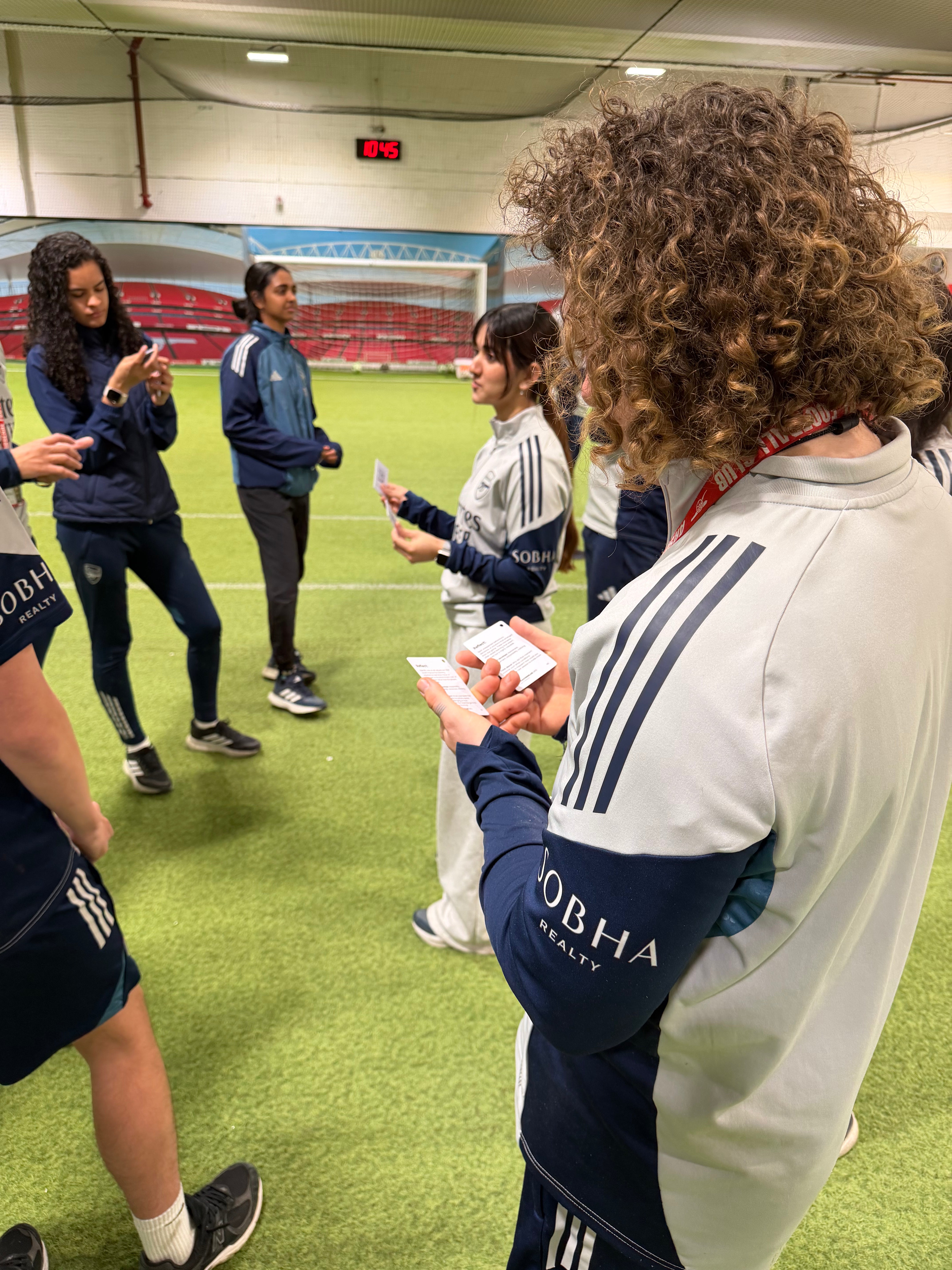
During a practical session with Arsenal in the Community coaches, we used Coach Challenge MatchPlay Cards to create an active professional development experience built around games, coaching challenges, peer feedback and shared reflection.
The coaches did not spend the session listening to somebody explain what effective coaching should look like. They were given opportunities to coach within the game, test different approaches, observe their colleagues and make sense of how their decisions affected the players.
This reflects one of our core beliefs at The Coaching Lab. Coach development should involve coaches in the learning process, not position them as passive recipients of somebody else’s knowledge.
Moving coach development beyond lectures
Traditional coaching CPD often follows a familiar format. A facilitator presents information, coaches take notes and everybody leaves with several ideas they intend to use in the future.
Presentations can introduce valuable concepts, but listening to somebody speak about coaching is very different from experiencing the decisions, uncertainty and pressure of actually coaching.
Coaching is active, social and constantly changing. Coach development should reflect that reality.
Our approach with the Arsenal in the Community coaches was built around co coaching. Coaches took turns leading, observing, experimenting and providing feedback to one another. The facilitator created the environment and supported the conversations, but was not positioned as the only person capable of contributing valuable knowledge.
The purpose was not to identify one correct way to coach. It was to help coaches notice more, test different approaches and understand the impact of their decisions.

Coaching while the game continued
One of the main themes of the session was coaching within the game.
Coaches can become dependent on stopping an activity whenever they want to explain, correct or reorganise something. Interventions can be valuable, but stopping too frequently can interrupt the flow of the game, reduce player decision making and make the activity dependent on the coach.
We wanted coaches to explore what else was possible.
Instead of immediately stopping the activity, coaches considered how they could influence the game through their positioning, questions, scoring systems, conditions, individual conversations and changes to the environment.
This required them to observe carefully and make decisions in the moment. They needed to recognise what was happening, consider what the players required and select an intervention that allowed the game to continue.
The game became the learning environment for both the players and the coaches.

Coaches selected their own challenges
Each coach used Coach Challenge MatchPlay Cards to select a practical challenge for themselves.
This gave coaches greater ownership of their development. They could choose a challenge connected to a behaviour they wanted to examine, an idea they wanted to test or an area of their coaching that had become comfortable.
Some challenges focused on communication and player engagement. Others encouraged coaches to reconsider their session design, interventions, observations or use of reflection.
Selecting a card gave each coach a clear mission. They knew what they were going to explore, while their peers knew what they could observe.
The challenge provided direction without prescribing one solution. Each coach had to interpret the card, consider the players in front of them and decide how to apply it.
Coaches selected challenges for their peers
We also invited coaches to select challenges for one another.
Choosing a card for a colleague required coaches to think carefully about what they had observed. They needed to identify a challenge that could help their peer explore a different behaviour or approach.
This made peer feedback more specific and useful.
Instead of saying, “That was good,” or, “You could communicate more,” coaches could connect their observations to a practical challenge. The recipient then had an action they could test, rather than another piece of general advice to remember.
Feedback became part of an ongoing learning process:
- The coach selected or received a challenge.
- They applied it within the game.
- Their peers observed the effect.
- The group discussed what happened.
- The coach selected what they wanted to retain or adapt.
- A new challenge created the next opportunity to learn.

Why co coaching is central to our CPD approach
Co coaching gives coaches opportunities to learn with and from one another.
One coach may lead the activity while another observes player engagement. A second observer might focus on who is making decisions, while somebody else notices how the lead coach uses questions or changes the environment.
The coaches can then exchange roles and experience a different challenge.
This approach makes professional development more collaborative. Coaches are not waiting for the facilitator to evaluate their performance, and feedback does not only travel from the most senior person in the room to everybody else.
Every coach contributes to the learning.
Co-coaching also helps develop the ability to give feedback. This matters because peer conversations are one of the most accessible forms of ongoing coach development available to clubs, schools and sporting organisations.
When coaches can challenge one another with curiosity, evidence and respect, professional development can continue long after the formal workshop has finished.
What good games can teach us about coach development
Gamification is often reduced to adding points, badges or prizes to an activity. However, the most valuable lessons from games are not about superficial rewards.
James Paul Gee’s research into good video games explores how well designed games create powerful learning. His principles include identity, interaction, agency, productive risk taking, customisation and feedback through the consequences of decisions.
In a well designed game, the player is not simply given information and then asked to remember it. They are given a problem, invited to act and shown the consequences of their choices. They can fail, adapt and try again without failure becoming the end of the learning process.
Amy Price and colleagues have applied these ideas to sports coaching through a Digital Video Games Approach. Their work considers how game design can help players become more aware of how they plan, solve problems, seek information and adapt strategies.
The intention is to develop good learners, not only good players.
We applied similar principles to the development of coaches during the session.
Challenges became coaching missions
Amy Price’s work highlights the value of using broad missions rather than prescribing the exact actions players must complete.
We treated the Coach Challenge MatchPlay Cards in a similar way. Each card created a coaching mission, but it did not provide a script or tell the coach exactly how to succeed.
The coach had to interpret the challenge, read the environment and select an appropriate response. Two coaches could receive the same challenge and approach it completely differently.
This encouraged coaches to think like designers rather than simply deliver somebody else’s instructions.
Coaches experienced agency and ownership
Gee identifies agency as an important principle of good game design. Players are more invested when their decisions genuinely influence what happens next.
The coaches experienced this by selecting challenges, choosing how to apply them and deciding how they would respond to what emerged during the activity.
They were not completing a predetermined task to satisfy the facilitator. They were making meaningful decisions about their development.
This ownership also influenced reflection. Coaches had selected the challenge, tested their approach and experienced the consequences, giving them something personally relevant to discuss afterwards.
The game provided immediate feedback
Good games respond to the decisions of the player.
The same principle applied during the coaching activity. When a coach changed a condition, delayed an intervention or asked a different question, the players responded. That response provided immediate information about the coaching decision.
The coach did not need to wait until the end of the session to discover whether something had changed. They could observe the game, interpret the response and adapt while the activity continued.
Peer observations provided another layer of feedback. Coaches could compare what they intended to create with what their colleagues and players actually experienced.
Coaches could take productive risks
Gee also highlights the importance of lowering the consequences of failure. Good games encourage players to explore, take risks and use unsuccessful attempts as information.
We wanted the coaching environment to create the same freedom.
Coaches could test unfamiliar approaches without feeling that every action was being assessed as right or wrong. If a challenge did not produce the response they expected, it created useful information and a reason to adapt.
This matters because coaches are unlikely to experiment when professional development feels like an assessment.
A strong coaching culture should allow practitioners to test ideas, question habits and acknowledge when something did not work as intended.
Challenges were customised to the coach
Good games provide an appropriate level of challenge and often allow problems to be solved in different ways.
The cards allowed coaches to select challenges that were relevant to their confidence, experience and current practice. A developing coach could focus on involving more players, while an experienced coach might explore surrendering control or changing the activity without stopping the game.
Peers could also choose challenges for one another based on what they had observed.
This made the development more personal than asking every coach to complete the same generic task. Coaches shared the experience, but the challenge could still meet them at an appropriate point in their development.
Developing coaches who think about their thinking
Amy Price’s research places particular importance on metacognition. This involves helping learners become more aware of how they plan, monitor and adapt their learning.
The same principle is valuable in coach development.
After each challenge, coaches considered what they noticed, why they made particular decisions and how their approach influenced the players. They were not simply learning another coaching technique. They were becoming more aware of how they solved coaching problems.
The aim was to develop coaches who could recognise what they needed to learn and actively seek solutions, rather than waiting for a Coach Developer to provide every answer.
From activity deliverers to game designers
The most powerful shift occurred when coaches stopped seeing the game as an activity to deliver and started seeing it as an environment they could design.
They considered how the mission, rules, scoring, space, player roles and available support could influence behaviour. They also explored how players could be given greater ownership over decisions, problem solving and when to seek help.
This is far more meaningful than adding a leaderboard or awarding points for completing a coaching challenge.
It uses the deeper learning principles of games to create coaches who can plan, experiment, observe, adapt and reflect.
How to use this approach with your coaching workforce
Clubs, schools, academies and community programmes can apply this approach without creating another lengthy development programme.
A practical co coaching session could follow this structure:
- Ask every coach to select a challenge.
- Give coaches time to consider how they might apply it.
- Allow one coach to lead while colleagues observe.
- Give observers different areas of focus.
- Discuss how the coaching challenge influenced the players.
- Invite peers to select the coach’s next challenge.
- Repeat the process with coaches exchanging roles.
This creates a continuous cycle of action, feedback, reflection and adaptation.
It also helps build a culture in which professional development is something coaches do together, rather than something delivered to them.
Make your next coaching workshop feel like coaching
Our session with Arsenal in the Community coaches demonstrated the value of making coach development practical, social and connected to the game.
The most powerful learning did not come from giving coaches more content. It came from creating meaningful challenges, allowing coaches to experiment and giving peers the responsibility to support one another through purposeful feedback.
Coach Challenge MatchPlay Cards contain 70 practical coach development challenges across ENGAGE, CHANGE and REFLECT.
They can help clubs, schools and sporting organisations:
- Create practical coaching workshops.
- Strengthen co coaching and peer feedback.
- Encourage coaches to experiment safely.
- Apply the learning principles of good games.
- Develop more reflective and adaptable coaches.
- Turn everyday sessions into ongoing professional development.
If you want coaches to become confident problem solvers, give them more than information.
Give them a meaningful challenge, permission to experiment and people who can help them learn from what happens.

Share:
The Coach Developer’s Toolkit: How to Build More Confident, Reflective and Player-Centred Coaches
Challenging Coaches in Singapore With ActiveSG and SGNA